

(Continued from Part 1)
Sōma Yauchi thought Japanese interpreters working alongside athletes were “cool.”
When he was in high school, English was not his strong subject. He played baseball but was not especially skilled at it, nor did he possess any remarkable talent.
After entering university in Japan, he began studying English and gradually realized that he was starting to understand it. Learning became enjoyable.
Filled with hope, he decided to study abroad and headed to Benguet State University in the Philippines.
He arrived brimming with confidence.
Yet nobody could understand his English.
Just when he had finally discovered a source of hope in his life—English—he faced a harsh reality.
I will master English no matter what.
The challenge he set for himself was simple:
Keep speaking English, relentlessly.
Even though he lacked confidence in conversation, he resolved to meet local people every day and start conversations himself.
He actively approached Filipinos, using every expression he knew. Through gestures, facial expressions, and real-life interactions, he learned English through practice.

Speaking Japanese would slow his progress, so he rarely met other Japanese people. Although there were other Japanese students studying abroad, they promised one another that they would communicate in English.
Filipinos enjoy talking. Many are open-minded and easygoing. Jokes are exchanged frequently. His friends were kind and eager to teach him. Whenever he said he wanted to practice English, they were willing to have conversations with him.
English is the second language of the Philippines. Because many Filipinos learned English as a second language themselves, they are often skilled at teaching it. Rather than relying on intuition, they explain things logically, which makes learning easier for Japanese students.
Yauchi had acquired Japanese, his native language, naturally and intuitively. He could not logically explain Japanese pronunciation or grammar. He was impressed by how well Filipinos could explain English in a logical way.
The English he learned in Japan contained a mixture of accents from countries such as the United Kingdom, the United States, and Australia.
In the Philippines, however, American English has a particularly strong influence. Sometimes when he spoke with a British accent, Filipinos could not understand him. Only after friends pointed it out did he realize that he had been using British pronunciation. When listeners had difficulty understanding him, he would spell the word aloud to help clarify his meaning.
Benguet State University offers Japanese-language classes. As an intern, Yauchi serves as a professor’s assistant every Wednesday. He teaches Filipino students about Japanese culture and tourist attractions—in English.
His internship also includes helping in university offices. Since most office documents in the Philippines are written in English, every aspect of daily life becomes English training.
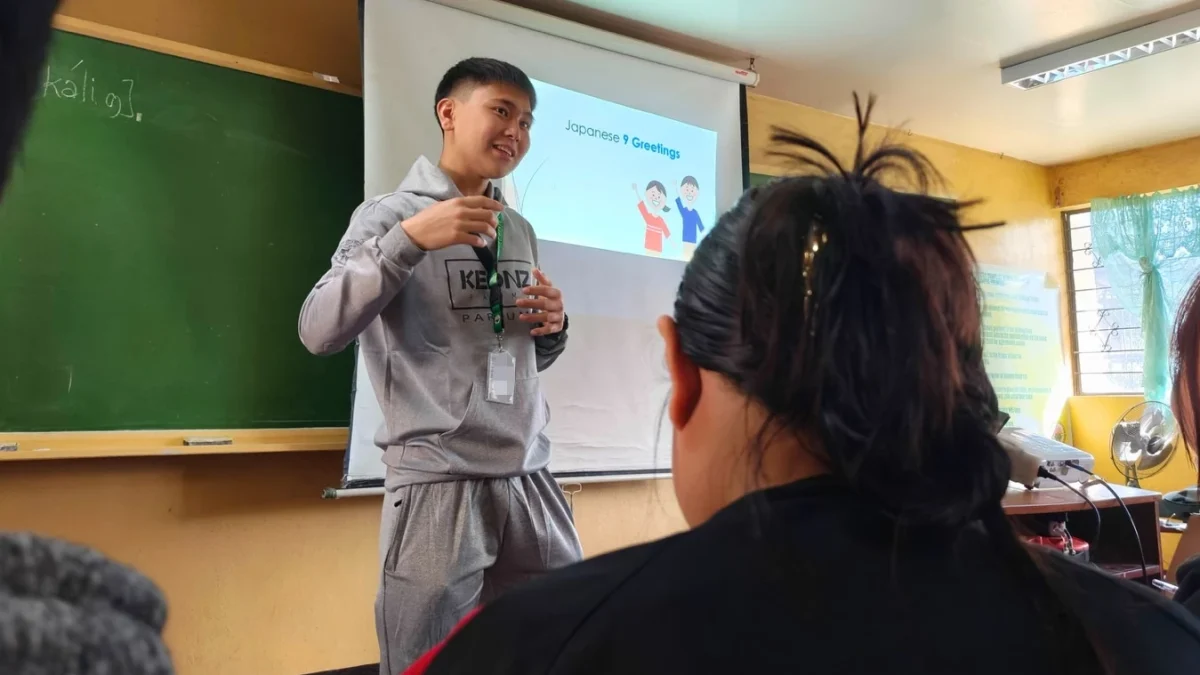
Yauchi sometimes watches videos produced by former Japanese national soccer player Keisuke Honda.
Honda speaks English fluently. Yauchi found it inspiring that a former top-level athlete was actively communicating in English.
Honda also supports children in developing countries. Whenever Yauchi felt discouraged in his English studies, Honda’s videos encouraged him to keep going.
In the future, Yauchi hopes to support Japanese people who venture abroad. Not only athletes, but also business professionals who need interpretation services.
He wants to build a career in international exchange and cooperation. He would also like to help children in developing countries. He is interested in organizations such as Japan International Cooperation Agency and the Japan Overseas Cooperation Volunteers.
There seems to be no end to the possibilities that English could open for him.
Reflecting on his journey, Yauchi says:
“There are times when I feel discouraged or find studying English difficult. But the joy of successfully communicating with someone outweighs the hardship. I genuinely enjoy studying and speaking English.”
In high school, English was not his strength.
He was not particularly good at baseball, either.
He did not possess any exceptional talent.
Yet through the language he has come to love, Sōma Yauchi is carving out his own future.
His future looks “cool”.

Related Articles